



Table of Contents
- What Is Bankruptcy Under UAE Law?
- Who Does the UAE Bankruptcy Law Apply To?
- Bankruptcy, Insolvency and Liquidation Are Not the Same
- What Options Exist Before Full Bankruptcy?
- Who Can File a Bankruptcy Application?
- What Happens When Bankruptcy Proceedings Begin?
- Does Bankruptcy Automatically Wipe Out Business Debts?
- What Does Bankruptcy Mean for Directors and Managers?
- What If the Business Also Has an FTA Tax Dispute?
- When Should a Business Consider Bankruptcy Advice?
- How HHS Lawyers Assists in UAE Bankruptcy Matters
- FAQs on Bankruptcy in the UAE
- Bankruptcy Is a Process, Not Just a Financial Label
What is bankruptcy in the UAE? In simple terms, bankruptcy is a court-supervised legal process for dealing with a business or commercial debtor that can no longer meet its financial obligations and cannot realistically continue in its present financial condition.
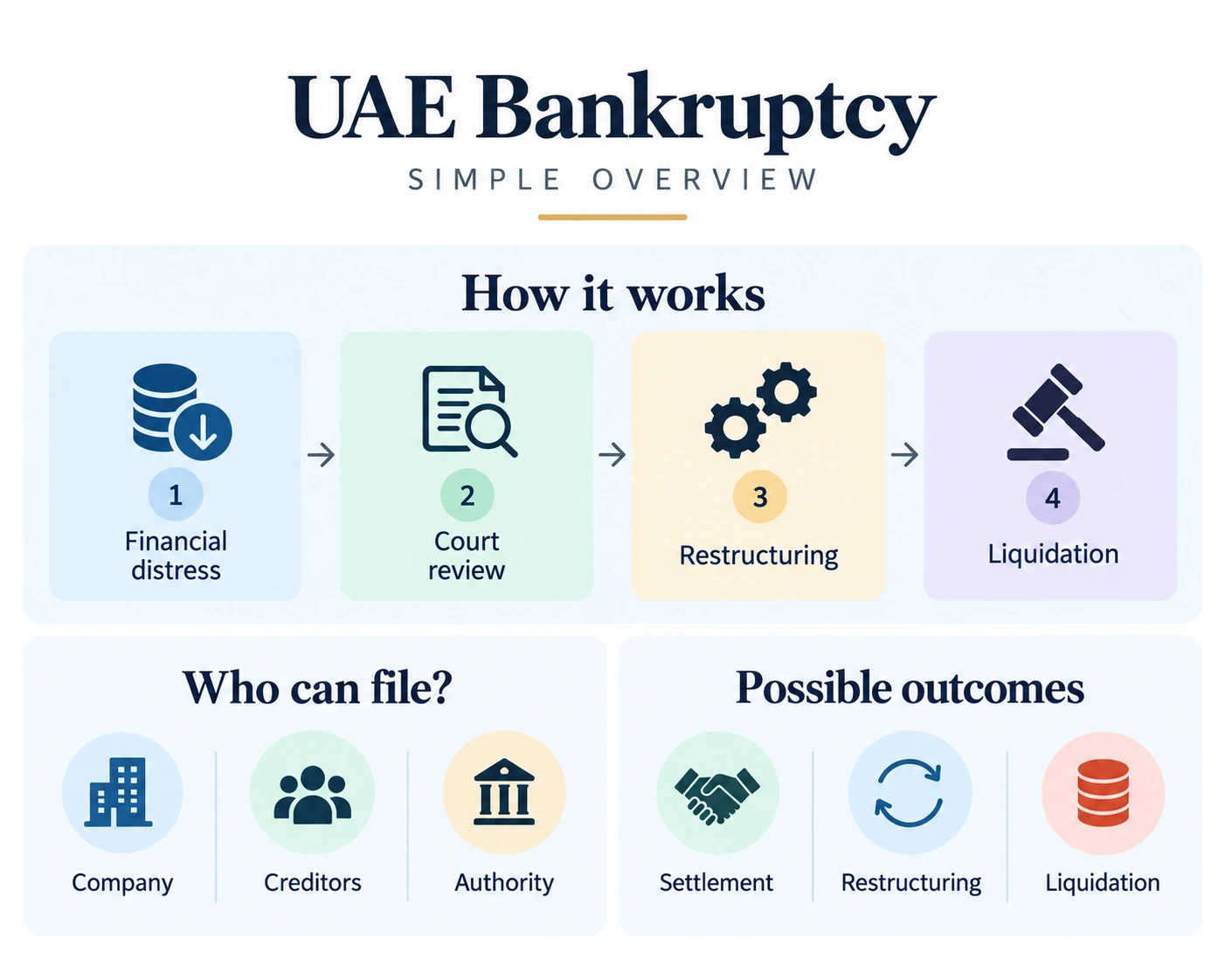
Bankruptcy does not always mean immediately closing a company and selling everything it owns. The current UAE framework provides different routes, including preventive settlement, financial restructuring and, where recovery is no longer viable, bankruptcy and liquidation.
For business owners, directors and creditors, the important question is therefore not simply whether a company has unpaid debts. It is whether the financial position has reached a stage where restructuring, settlement or formal bankruptcy proceedings should be considered.
Businesses facing serious financial distress can speak with HHS Lawyers’ bankruptcy and insolvency lawyers to assess the available legal route before creditor pressure or enforcement action develops further.
What Is Bankruptcy Under UAE Law?
The current UAE business-bankruptcy framework is primarily governed by Federal Decree-Law No. 51 of 2023 Promulgating the Financial and Bankruptcy Law, together with Cabinet Resolution No. 94 of 2024 containing its Executive Regulations.
The law is designed to deal with financial distress in an organised way. Its objectives include protecting creditor rights, helping debtors settle obligations where possible, preserving business value and avoiding liquidation where a viable solution still exists.
This means bankruptcy should not automatically be viewed as the first response to financial difficulty. The law provides mechanisms that can preserve a viable business where creditors and the debtor can work within a structured court-supervised process.
Need Bankruptcy Guidance?
Dubai's Expert Advice at Your Fingertips.

Who Does the UAE Bankruptcy Law Apply To?
The federal bankruptcy law applies to several categories of commercial debtors, including:
- Companies subject to the UAE Commercial Companies Law
- Natural persons who have the legal capacity of a trader
- Licensed civil companies of a professional nature
Not every person who cannot pay a debt falls under the same law.
A non-trader individual dealing with personal debts is generally covered by the separate UAE personal insolvency framework under Federal Decree-Law No. 19 of 2019. Individuals dealing primarily with personal financial obligations can review HHS Lawyers’ personal insolvency support rather than assuming the corporate bankruptcy procedure applies to them.
DIFC and ADGM entities also operate within separate insolvency frameworks, so the jurisdiction of the debtor should be checked before relying on the federal procedure.
Bankruptcy, Insolvency and Liquidation Are Not the Same
These terms are often used interchangeably, but they describe different concepts.
Financial distress or insolvency refers broadly to a situation where a debtor is struggling or unable to meet debts as they become due.
Bankruptcy is a formal legal proceeding under which the court deals with a qualifying debtor’s financial failure according to the applicable law.
Liquidation involves identifying and selling assets and distributing the proceeds according to legal priorities. Liquidation becomes relevant where preserving or restructuring the business is no longer realistic.
A company facing payment problems should therefore not assume that liquidation is inevitable. The business can first need an assessment of whether settlement or restructuring remains commercially and legally workable.
What Options Exist Before Full Bankruptcy?
Preventive Settlement
Preventive settlement provides a framework for addressing financial difficulty before the situation reaches full bankruptcy and liquidation. It allows a debtor to work toward an arrangement with creditors while operating within the statutory process.
The objective is to address the debt problem early enough that a workable settlement can still preserve value.
Financial Restructuring
Financial restructuring is intended for situations where the debtor’s obligations need to be reorganised but the underlying business remains capable of continuing.
A restructuring plan can deal with repayment arrangements and creditor treatment under court supervision. Whether restructuring is realistic depends on the company’s financial position, assets, liabilities, cash flow and ability to continue operating.
Businesses considering restructuring should also review corporate obligations, shareholder exposure and management decisions. HHS Lawyers’ corporate legal team advises businesses on restructuring, insolvency risk and directors’ responsibilities under UAE law.
Bankruptcy and Liquidation
Full bankruptcy becomes relevant where the debtor has stopped paying, has a financial deficit and the business is no longer viable.
Once bankruptcy proceedings move into liquidation, the debtor’s assets are dealt with under the court-supervised process, creditor claims are reviewed and available proceeds are distributed according to the priorities established by law.
Who Can File a Bankruptcy Application?
A bankruptcy or restructuring process can be initiated by different parties when the statutory conditions are met. These include the debtor itself, qualifying creditors and, in certain regulated cases, the relevant regulatory authority.
The current Executive Regulations also set financial thresholds for applications.
- A debtor application requires unpaid or expected-unpayable debt of at least AED 300,000 where the debtor is a natural-person trader.
- For a legal person, the debtor threshold is AED 500,000.
- An ordinary creditor or group of ordinary creditors generally needs qualifying unpaid debt of at least AED 1 million to initiate restructuring or bankruptcy proceedings.
Higher thresholds apply to debtors supervised by regulatory authorities.
These thresholds determine access to the statutory procedure; they should not be treated as a general rule that every business with debt above those amounts is automatically bankrupt.
For a more detailed filing discussion, see HHS Lawyers’ guide on how bankruptcy proceedings are filed in the UAE.
What Happens When Bankruptcy Proceedings Begin?
Bankruptcy proceedings bring the debtor’s financial affairs into a structured legal process rather than leaving individual creditors to pursue competing recovery measures without coordination.
Depending on the procedure opened by the court, this can involve:
- Review of the debtor’s financial position
- Identification of assets and liabilities
- Verification of creditor claims
- Appointment of a trustee or other court-supervised professional where required
- Restrictions on dealing with certain assets
- Review of transactions affecting creditor rights
- Preparation or consideration of restructuring proposals
- Liquidation where continued operation is not viable
Bankruptcy therefore affects more than the company’s immediate ability to pay bills. It can change how management deals with assets, creditors, litigation and ongoing business decisions.
Does Bankruptcy Automatically Wipe Out Business Debts?
No. Bankruptcy should not be understood as a simple cancellation of everything a company owes.
The procedure identifies claims, assets and creditor rights and determines how the debtor’s financial position will be dealt with under the law. Secured creditors, government claims, employee entitlements and other categories of liabilities can receive different treatment according to the applicable statutory priorities.
Where liquidation occurs, available assets are realised and distributed through the bankruptcy process. Directors and managers should therefore avoid assuming that filing bankruptcy itself removes every financial or legal exposure.
What Does Bankruptcy Mean for Directors and Managers?
Financial distress also creates responsibilities for the people managing the company.
The UAE Bankruptcy Law contains provisions addressing management conduct before bankruptcy. In certain circumstances, directors, managers or persons responsible for actual management can face liability where their actions contributed to the financial deterioration of the company.
Examples identified in the law include transactions for inadequate value, favouring particular creditors to the detriment of others and continuing certain high-risk conduct intended to delay bankruptcy.
For this reason, management should document decisions carefully once serious financial problems become apparent and obtain advice before transferring assets, favouring creditors or entering unusual transactions.
What If the Business Also Has an FTA Tax Dispute?
Financial distress and an FTA dispute are separate legal issues, even where they occur at the same time.
A company facing an FTA assessment, administrative penalty or disputed Corporate Tax or VAT liability should not assume that bankruptcy automatically resolves the underlying tax dispute. The validity of the FTA decision and the appropriate bankruptcy treatment of a tax liability involve different procedures.
Where a material tax assessment is contributing to the company’s financial difficulties, HHS Lawyers’ tax dispute team can review the FTA decision and the available administrative or court challenge alongside the wider financial-distress strategy.
When Should a Business Consider Bankruptcy Advice?
One missed payment does not necessarily mean a company should file for bankruptcy. The warning signs become more serious when several financial problems begin occurring together.
Legal review is particularly useful where:
- The business repeatedly cannot meet debts when due
- Multiple creditors are demanding payment or beginning enforcement
- Bank facilities have been withdrawn or accelerated
- Cash flow no longer supports ordinary operations
- Directors are considering asset sales to fund overdue liabilities
- Creditor negotiations have stalled
- A restructuring proposal needs formal court protection
- The business no longer appears commercially viable
Acting early preserves more options. Waiting until several creditors have already taken enforcement action can reduce the scope for an orderly restructuring.
How HHS Lawyers Assists in UAE Bankruptcy Matters
HHS Lawyers assists companies, business owners, directors and creditors with bankruptcy, insolvency and restructuring matters in the UAE.
The legal work can include reviewing the debtor’s financial and legal position, assessing whether preventive settlement, restructuring or bankruptcy is appropriate, preparing court applications and supporting documents, dealing with creditor claims and advising management on its obligations during financial distress.
Where a bankruptcy application has already been filed, the legal strategy also needs to account for court deadlines, trustee requests, creditor disputes and the effect of proceedings on the company’s assets and ongoing business.
FAQs on Bankruptcy in the UAE
Q1. What is bankruptcy in the UAE?
Bankruptcy is a court-supervised legal process for qualifying commercial debtors that are unable to meet their financial obligations and whose financial position requires settlement, restructuring or liquidation under UAE law.
Q2. Does bankruptcy always mean a company will close?
No. The UAE framework includes preventive settlement and financial restructuring, which can preserve a viable business. Liquidation becomes relevant where recovery or continuation is no longer workable.
Q3. Can an individual declare bankruptcy in the UAE?
A natural person with trader status can fall under the business-bankruptcy framework. A non-trader dealing with personal debts generally falls under the separate UAE personal insolvency law.
Q4. Can a creditor file bankruptcy proceedings against a company?
Yes, where the legal conditions and minimum debt threshold are satisfied. The Executive Regulations currently set a general AED 1 million threshold for an ordinary creditor or group of ordinary creditors.
Q5. Is bankruptcy the same as liquidation?
No. Bankruptcy is the formal legal process, while liquidation is one possible outcome where assets are sold and proceeds distributed because restructuring is not viable.
Q6. When should a company speak to a bankruptcy lawyer?
A company should seek advice when payment defaults are recurring, creditor enforcement is escalating, restructuring discussions are failing or management is concerned that the business can no longer continue meeting its obligations.
Need Bankruptcy Guidance?
Dubai's Expert Advice at Your Fingertips.
Bankruptcy Is a Process, Not Just a Financial Label
Bankruptcy in the UAE is not simply another word for owing money. It is a formal legal framework for dealing with serious commercial financial distress through settlement, restructuring or, where necessary, liquidation.
The earlier a business understands its financial position and the available legal routes, the more options it generally has for protecting business value, addressing creditor claims and managing management risk. HHS Lawyers can review the circumstances and advise on the appropriate bankruptcy and insolvency process in the UAE.
