



Table of Contents
- Can WhatsApp Messages Be Used as Evidence in UAE Courts?
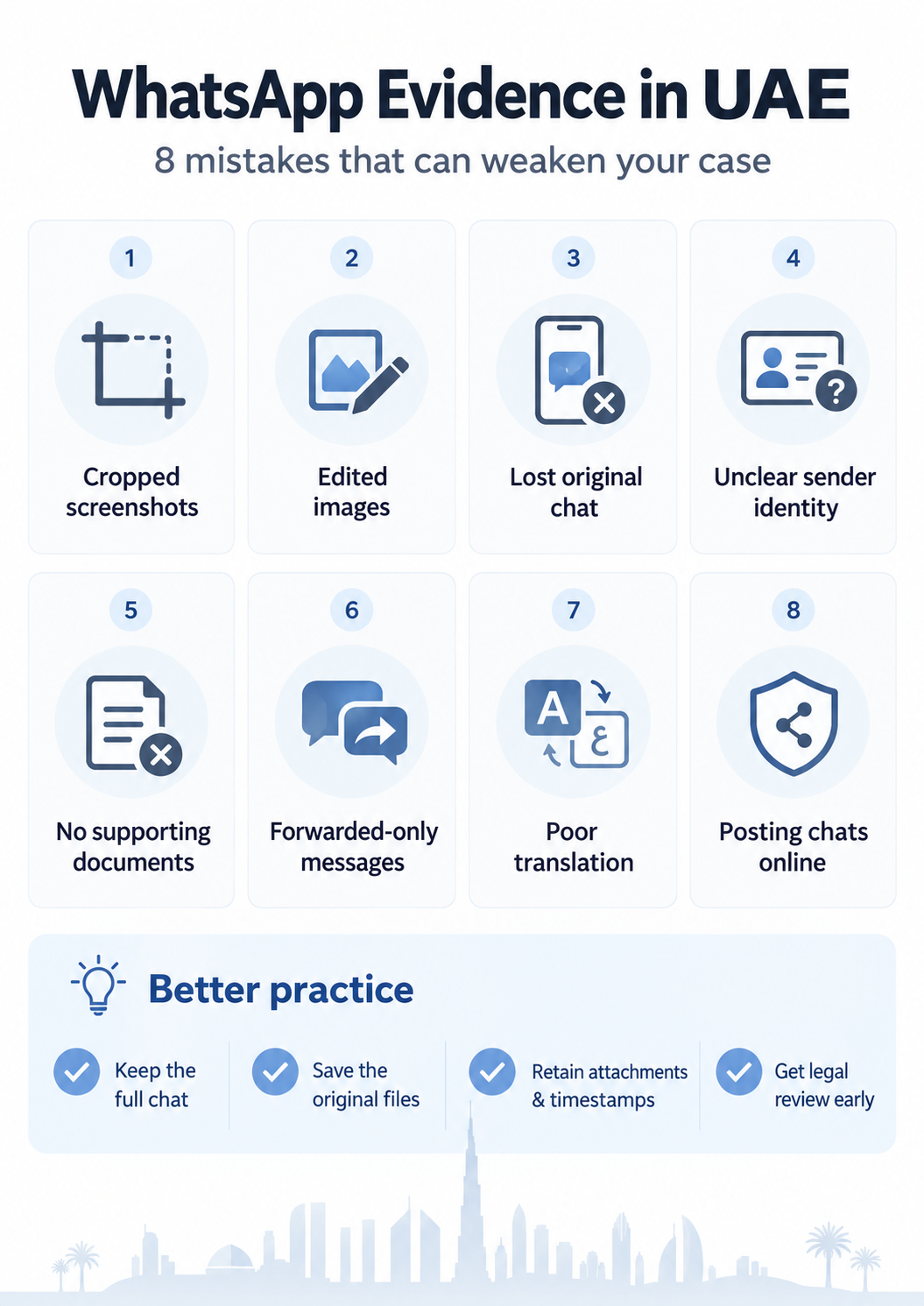
- 1. Submitting Only Cropped Screenshots
- 2. Editing, Annotating or Altering the Original Screenshot
- 3. Saving the Screenshot but Losing the Original Conversation
- 4. Failing to Show Who Actually Sent the Messages
- 5. Presenting Messages Without the Surrounding Contract or Documents
- 6. Relying on Forwarded or Copied Messages Instead of the Source
- 7. Using an Inaccurate or Incomplete Translation
- 8. Publishing Private WhatsApp Screenshots Online
- What Should You Preserve Before a Dispute Escalates?
- What If the Other Party Denies the WhatsApp Messages?
- Can a WhatsApp Message Prove a Contract or Debt?
- When WhatsApp Evidence Becomes a Criminal Issue
- Prepare the Evidence Before You Build the Case Around It
- FAQs on WhatsApp Messages as Evidence in the UAE
WhatsApp messages can form part of the evidence in a UAE legal dispute, but having screenshots on your phone does not automatically mean they will prove your case.
Under the current UAE Law of Evidence, electronic correspondence and modern means of communication fall within the framework for electronic evidence. The real issue is usually not whether a WhatsApp conversation exists, but whether the messages can be connected to the parties, understood in context and verified if their authenticity is challenged.
This becomes particularly important in contractual disputes, unpaid debt claims, employment disagreements, partnership disputes, property matters and other cases where important instructions, promises, acknowledgements or negotiations happened through WhatsApp.
If a dispute is already developing, HHS Lawyers’ litigation and dispute resolution team can review the messages together with the contracts, payment records and other evidence before a claim or defence is prepared.
Can WhatsApp Messages Be Used as Evidence in UAE Courts?
Yes. Federal Decree-Law No. 35 of 2022 on Evidence in Civil and Commercial Transactions expressly recognises electronic evidence, including electronic correspondence and modern means of communication.
The law subjects electronic evidence to the rules governing documentary evidence. It also allows the court to require electronic evidence in its original format or through another electronic means and to request material needed to verify its validity.
This means a WhatsApp conversation should not be treated as automatically conclusive simply because a screenshot exists. The court can consider authenticity, relevance, context and the surrounding evidence when deciding what weight to give it.
The following mistakes can make otherwise useful WhatsApp evidence much harder to rely upon.
Need Legal Help?
Dubai's Expert Advice at Your Fingertips.

1. Submitting Only Cropped Screenshots
A screenshot showing one sentence can look compelling until the rest of the conversation is examined.
Cropping out the messages immediately before or after the statement can remove the context needed to understand what the sender meant. It can also create an argument that the evidence has been selectively presented.
For example, a screenshot saying:
“Yes, I will pay it next week.”
can appear to be an acknowledgement of debt. But the earlier messages may show that the parties were discussing a different invoice, negotiating a settlement or referring to an amount owed by another person.
Preserve the wider conversation. If a particular message is important, identify it within the full thread rather than keeping only an isolated image.
2. Editing, Annotating or Altering the Original Screenshot
Adding arrows, covering information, changing contact names, combining several screenshots into one image or using editing software can create unnecessary questions about authenticity.
You can prepare an annotated copy later for explanation, but the unaltered source material should also be preserved.
The same principle applies to the underlying chat. Do not delete messages simply because they appear unhelpful. Selective deletion can make verification more difficult and may affect the credibility of the remaining material.
Where electronic evidence is disputed, the ability to produce the original data or material capable of verification can become important under the UAE Evidence Law.
3. Saving the Screenshot but Losing the Original Conversation
A screenshot is convenient, but it is not the only thing you should preserve.
If the dispute is serious, retain the original device and conversation where possible. Also preserve relevant attachments, voice notes, documents and other files exchanged through the same chat.
Depending on the case, useful preservation steps can include:
- keeping the original WhatsApp conversation on the device;
- exporting the relevant chat without altering it;
- preserving the sender’s phone number and account information;
- keeping timestamps visible;
- retaining attached invoices, PDFs, photographs or voice notes; and
- keeping related emails, contracts and payment records.
A dispute often becomes stronger when the WhatsApp conversation supports other independent evidence rather than standing alone.
4. Failing to Show Who Actually Sent the Messages
A contact name displayed as “Ahmed,” “Boss” or “ABC Company” does not by itself establish the legal identity of the person behind the account.
If the other party disputes authorship, attribution can become a key issue.
Preserve information that can connect the WhatsApp account to the person or company involved, such as the full telephone number, previous correspondence using that number, business records, contracts, invoices or communications in which the person identifies themselves.
For company disputes, also consider whether the individual communicating through WhatsApp actually had authority to speak or agree on behalf of the business.
A message can be genuine but still have limited value if the person sending it had no authority to make the alleged commitment.
5. Presenting Messages Without the Surrounding Contract or Documents
WhatsApp evidence rarely exists in isolation.
In a commercial dispute, the court may also need to understand the signed contract, purchase orders, invoices, delivery records, bank transfers, emails and notices exchanged between the parties.
A message that appears to change a payment date, approve additional work or acknowledge a liability needs to be read against the wider legal relationship.
This is why evidence should be reviewed as a complete file rather than as a collection of screenshots.
<blockquote> Our guide on how evidence is evaluated in UAE courts explains how documentary, electronic and other evidence can work together in a dispute. </blockquote>
6. Relying on Forwarded or Copied Messages Instead of the Source
A forwarded WhatsApp message or text copied into another conversation does not provide the same context as the original exchange.
The UAE Evidence Law allows courts to require electronic evidence in its original format or by another electronic means. If authenticity becomes disputed, relying only on a forwarded copy can make verification harder.
Where possible, preserve the original chat from which the message came.
The same applies when someone sends you a screenshot of a conversation between two other people. That image may still be relevant to understanding the dispute, but it raises additional questions about where it came from, whether it is complete and whether the underlying conversation can be verified.
7. Using an Inaccurate or Incomplete Translation
Messages written in English, Urdu, Hindi, Arabic or another language can contain informal expressions, abbreviations, voice notes and context-specific wording that changes the meaning of a statement.
A poor translation can therefore distort important evidence.
For proceedings before Dubai Courts, supporting documents are submitted in Arabic and the court’s published requirements call for legal translation approved in the UAE where documents are in another language.
Do not translate only the sentence that appears favourable while ignoring the surrounding conversation. The translated material should preserve the meaning and context of the original.
Where court-ready translation is required, HHS Lawyers can also assist with legal translation of documents and supporting material.
8. Publishing Private WhatsApp Screenshots Online
There is an important difference between preserving a conversation for a legal dispute and posting someone’s private messages publicly.
UAE cybercrime legislation protects privacy in electronic communications. Federal Decree-Law No. 34 of 2021 contains offences relating to invasion of privacy, including certain recording, transmission, disclosure and publication of private communications or information without consent in circumstances covered by the law.
Do not post WhatsApp screenshots on social media simply because you believe they prove your position. Public disclosure can create a separate legal problem even when the underlying dispute is genuine.
The safer approach is to preserve the evidence and provide it through the appropriate legal, police, prosecution or court channel where relevant.
For more on the distinction between evidence preservation and public posting, see the guide to UAE social media and privacy rules.
What Should You Preserve Before a Dispute Escalates?
If a WhatsApp conversation could become important to a claim or defence, preserve more than the individual message that appears useful.
- The complete relevant chat history
- The original device where reasonably possible
- The other party’s full number and identifying details
- Timestamps
- Voice notes and attachments
- Related contracts and amendments
- Invoices and purchase orders
- Bank-transfer or payment records
- Related email correspondence
- Any legal notices already exchanged
Do not create a new version of the evidence merely for convenience and then discard the original.
What If the Other Party Denies the WhatsApp Messages?
A denial does not automatically make the conversation useless, but it changes the evidentiary issue.
Under the UAE Evidence Law, a party alleging invalidity of certain electronic evidence bears the burden provided by the statute, while the court also has powers to require material needed to verify electronic evidence.
The practical response depends on what exactly is disputed. The other party may deny:
- owning the telephone number;
- sending the particular message;
- the completeness of the screenshot;
- the meaning of the conversation;
- the authority of the sender to bind a company; or
- the accuracy of a translation.
That is why preserving the original conversation and supporting records before litigation begins can matter significantly.
Can a WhatsApp Message Prove a Contract or Debt?
It can contribute to proving one, but the answer depends on what the conversation actually shows and what other evidence exists.
For example, messages may help evidence an acknowledgement of an amount due, instructions for work, acceptance of delivery, negotiations, agreed payment timing or another fact relevant to the dispute.
However, a casual conversation should not automatically be treated as a complete contract. The court can need to consider the surrounding agreement, legal requirements, authority of the sender and the complete communication between the parties.
When WhatsApp Evidence Becomes a Criminal Issue
Some WhatsApp disputes go beyond civil or commercial litigation.
Messages containing threats, blackmail, alleged defamation, harassment or other conduct can lead to police or Public Prosecution issues under the applicable criminal and cybercrime laws.
In those circumstances, do not alter the conversation or retaliate publicly. Preserve the relevant evidence and obtain advice on the correct complaint or defence procedure. HHS Lawyers’ criminal lawyers assist where digital communications form part of a criminal complaint or investigation.
Prepare the Evidence Before You Build the Case Around It
WhatsApp messages can be valuable evidence, but their strength depends heavily on how they are preserved and presented.
A complete conversation with identifiable parties, original records and supporting documents is generally more useful than a cropped screenshot presented without context. Translation, authenticity, privacy and the underlying legal relationship also need to be considered before a claim or defence is built around the messages.
HHS Lawyers assists individuals and businesses with reviewing electronic communications, contracts and supporting records as part of litigation and dispute resolution matters in the UAE.
Need Legal Help?
Dubai's Expert Advice at Your Fingertips.
FAQs on WhatsApp Messages as Evidence in the UAE
Q1. Can WhatsApp messages be used as evidence in UAE courts?
Yes. The UAE Evidence Law recognises electronic correspondence and modern means of communication as forms of electronic evidence. The court can still assess authenticity, relevance and evidential weight in the circumstances of the case.
Q2. Is a screenshot alone enough to prove my case?
Not necessarily. A screenshot can be useful, but the full conversation, sender identity, original electronic record and supporting contracts or payment documents can become important if the evidence is disputed.
Q3. Should I delete WhatsApp messages that damage my position?
No. Do not alter or selectively delete material once a dispute is developing. Preserve the original conversation and let your lawyer assess which evidence is legally relevant.
Q4. What happens if the other person denies sending the messages?
The dispute may then focus on authenticity and attribution. Preserving the original chat, telephone number, device, timestamps and related communications can assist when the evidence needs to be verified.
Q5. Do WhatsApp messages need Arabic translation for a Dubai court case?
Where non-Arabic material is submitted as supporting documentation to Dubai Courts, the court’s published requirements call for legal Arabic translation approved in the UAE. The translation should accurately preserve the context of the conversation.
Q6. Can I post the WhatsApp screenshots online if they prove my case?
Do not assume that you can. UAE privacy and cybercrime rules can apply to the disclosure or publication of private communications. Preserving a message for legal proceedings is different from publishing it publicly.
