



Table of Contents
- Muslims in Dubai: Can they write a Will?
- The Islamic Rule on the Writing of a Will (Wasiyyah).
- One-Third Rule of Islamic Wills.
- Will a Muslim be able to alter Heirs by a Will?
- What Can a Muslim Incorporate in a Will in Dubai?
- The Muslim Wills and the UAE Personal Status Law.
- Is it possible that Muslim Expatriates Can choose to use Civil Wills in Dubai?
- Muslim Will Write Without a Lawyer Is it a Good Idea?
- Significance of Legal Advice of Muslim Wills in Dubai.
- Frequently Asked Questions
- Final Legal Insight
Whether Muslims can write a will in Dubai or not is one of the most common questions of the inheritance and personal status that are raised in the UAE. Although it is usual to write a will in Islam, the regulations that regulate the writing of the wills by the Muslims residing in Dubai are based on a mixture of the Sharia and the UAE personal status laws, which complicates this issue on legal grounds.
This paper describes the Islamic regulation of writing a will, its application to the case of Dubai and what Muslims should be aware before they write a will in the UAE, in line with the general legal process of how to write a will in Dubai.
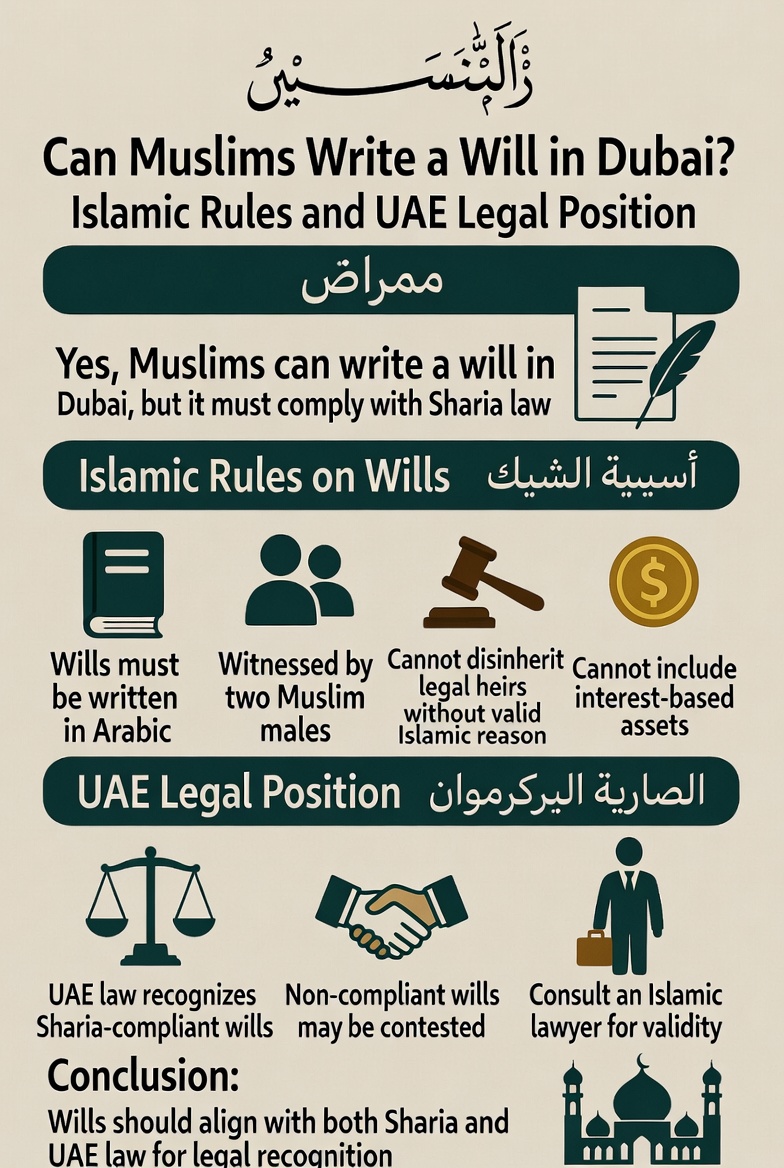
Muslims in Dubai: Can they write a Will?
Sure, it is possible to write a will in Dubai, yet the extent and scope of a will is different when it comes to Muslims as compared to non-Muslims.
Under UAE law:
The Sharia law influences largely the Muslim inheritance.
The will of a Muslim cannot supersede the compulsory Sharia inheritance, but within the scope of the law.
It implies that, although a Muslim can write a will, it will not be allowed to enforce it under the strict rules of religion and law.
Need Legal Help?
Dubai's Expert Advice at Your Fingertips.

The Islamic Rule on the Writing of a Will (Wasiyyah).
It is in writing a will (Wasiyyah) in the Islamic jurisprudence:
Permissible
Encouraged
In other cases, suggested or mandatory.
According to the Prophet Muhammad (peace be upon him), a Muslim should not fail to have his or her will written within two nights, and this shows the importance of having a written will in Islam.
Nevertheless, the Sharia law puts definite restrictions of what a will can consist of.
One-Third Rule of Islamic Wills.
A third of the rule is one of the most crucial Islamic provisions on writing a will.
Under Sharia principles:
A Muslim is allowed to dispose one-third (1/3) of his or her estate via a will.
The other two-thirds (2/3) will have to be divided as strictly as possible based on fixed Quranic shares of inheriting.
Legal heirs cannot inherit anything through the will unless the other heirs agree upon the death of the beneficiary.
This is regardless of the nationality, residence and asset value.
Will a Muslim be able to alter Heirs by a Will?
No.
When a Muslim is using Will, he or she cannot change the fixed shares of heirs according to the Sharia law.
For example:
A Muslim is not able to give all assets to the spouse.
A Muslim will not be able to leave children or parents out.
A Muslim is not able to bequeathed one heir more than the other one in a will.
Any provision which tries to do so is void under the Islamic law as well as the UAE courts.
What Can a Muslim Incorporate in a Will in Dubai?
A Muslim in Dubai is permitted to incorporate:
Bequest was to be made of one-third of the estate to:
Non-heirs
Charities
Friends
Appointment of an executor
Debt, funeral, obligation instructions.
Ethical or personal directives (not binding)
The will should not be in opposition to Sharia rules of inheritance.
The Muslim Wills and the UAE Personal Status Law.
The UAE Personal Status Law reaffirms that:
The Islamic Sharia controls Muslim inheritance issues.
By default, a court will exercise the Sharia rule when there is not a valid Sharia-compliant will.
Sharia laws still dominate conflicting provisions even with a will.
This applies to:
UAE nationals
Muslim expatriates
UAE based assets.
Explore : Will Writing Services
Is it possible that Muslim Expatriates Can choose to use Civil Wills in Dubai?
As of now:
Expatriates in Dubai who are Muslims are normally under the Sharia inheritance.
This is not the default decision among Muslims who have civil wills that override the Sharia rules.
There are some small advancements in some of the Emirates, but this is one of the emerging and delicate legal spheres.
Muslim expatriates who want to apply non-Sharia estate planning should consult particular legal counsel, where the wrong structuring may make the will useless.
Muslim Will Write Without a Lawyer Is it a Good Idea?
Although a Muslim can technically prepare a will without the help of a lawyer, this is highly legally dangerous, including:
Violating the one-third rule
Identifying ineligible beneficiaries
Improper execution
Rejection by UAE courts
Wills that are Sharia compliant must be done with accuracy and mistakes normally lead to partial or complete nullification.
Significance of Legal Advice of Muslim Wills in Dubai.
The professional legal advice guarantees:
Observance of Islamic rules of inheritance.
Conformity to court procedures in the UAE.
Adequate implementation and reports.
Avoidance of the conflict between heirs.
Particularly, it is necessary when:
The estate contains business or real estate.
There are multiple heirs
The assets are located in different countries.
Frequently Asked Questions
Is it possible to write a will in Dubai by Muslims?
Will a Muslim override the Sharia law in Dubai?
Is it possible that a Muslim gives everything in the will to his spouse?
Does a handwritten Islamic will work in Dubai?
Need Legal Help?
Dubai's Expert Advice at Your Fingertips.
Final Legal Insight
Although in Dubai, Muslims can write will, the role of a will is restricted by the Islamic law. A Muslim will is not an instrument to reorganize the inheritance, but an instrument of carrying out the religious obligations, handling the obligations, and distributing the allowed third of the estate lawfully.
It is important to know the Islamic law regarding writing will and the laws of the UAE so that the will is acceptable, enforceable, and its contents are upheld by the judiciary.
