



Table of Contents
- The importance of Writing a Will in the UAE.
- Can You Write a Will in the UAE?
- Will writing in the Dubai
- The Dubai legal requirements of writing a will.
- Writing Will without a Lawyer in Dubai, Is it Legal?
- The UAE Legal Will with a Lawyer.
- Writing a Will in Dubai vs Writing a Will in Abroad.
- How many dirhams to write a will in UAE.
- Frequently asked questions (FAQs)
- Final Thoughts
Composing will in UAE is an important legal procedure that the expatriates and citizens of the country who desire to provide a will on how they are to be distributed among their assets and not handed over to the default inheritance laws in the UAE. A lot of people think that the wills written in their home country are good enough, but it does not always happen in accordance with the UAE will laws.
This guide describes the process of how to write a will in the UAE, the legal necessities in Dubai, and whether to write a will or hire a lawyer, and it is made clear what is legally and enforceably binding.
The importance of Writing a Will in the UAE.
UAE has various rules concerning inheritance basing on religion, nationality and the law that is applied. In the absence of a valid will:
- The assets based in the UAE can be shared in accordance with the Sharia rules of inheritance.
- Courts may dictate guardianship of minor children.
- Bank accounts and property can be frozen until succession proceedings are won, as commonly seen when an expatriate dies in the UAE without a will.
- An agreement that respects the legal requirements of writing a will in Dubai guarantees:
- Asset distribution control.
- Spouse and child protection.
- Guardians of minors appointed.
Eschew the tedious court battles.
Need Legal Help?
Dubai's Expert Advice at Your Fingertips.

Can You Write a Will in the UAE?
Yes you can write a will in the UAE but the manner of writing it will either render the will legally valid and enforceable.
These are three general approaches:
- Do it yourself (DIY) writing a will.
- Writing a will with a lawyer.
- Making a will at an authorised body.
Both alternatives have various legal implications.
Will writing in the Dubai
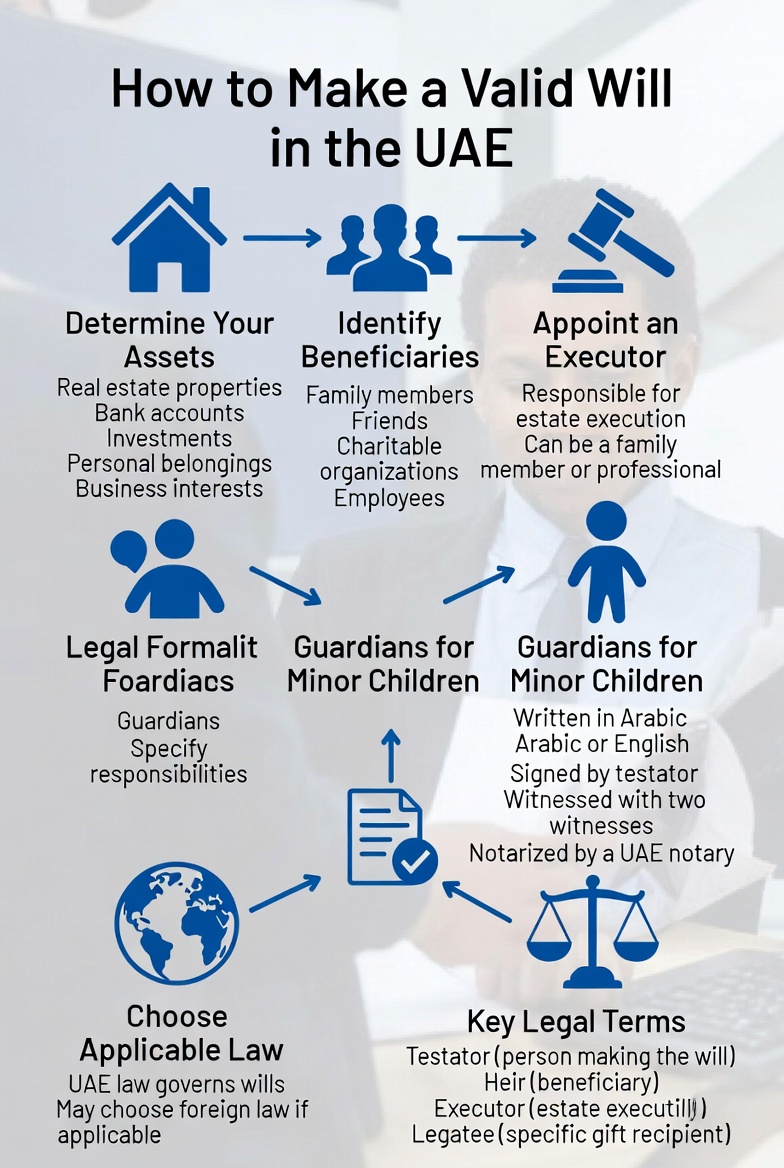
1. Determining the Assets of the Will.
A UAE will typically covers:
- Real estate in the UAE.
- Bank accounts, investments.
- Stocks and company investment.
- Vehicles and valuables.
- Personal belongings.
You can also incorporate other assets that are not located in the UAE, subject to jurisdiction and conflict of law.
2. Make a decision regarding the Beneficiaries.
Clearly identify:
- Spouse.
- Children.
- Parents or other relatives.
- Certain persons or organizations.
Bad descriptions of the beneficiaries of an agreement mostly result into conflicts and will disputes and litigation.
3. Appoint an Executor.
It is the duty of an executor to:
- Implementing the will.
- Control of distribution of assets.
- Dealing with court and administrative requirements.
This may be either a reliable person or a professional killer.
4. Visit Guardians to Minor Children.
This is one of the most important sections of a UAE will in the case you have minor children. Without a will:
- The UAE courts make decisions related to guardianship.
- State authorities can be given temporary guardianship.
- A will allows you to:
- Hire permanent guardians.
- Appoint interim guardians.
Give financial guidance to child welfare.
5. Choose the Applicable Law.
Non-Muslims may specify:
- Their home country law, or
- Law of civil personal status of UAE.
This provision is necessary to prevent automatic usage of Sharia rules of inheritance and is particularly relevant under wills and inheritance laws for non-Muslims in the UAE.
6. Write the Will in Correct Legal terms.
In order to be effective in Dubai a will needs to:
- Be clear and unambiguous.
- Be able to identify the testator.
- Be signed voluntarily.
- Sound mental capacity reflects.
One of the reasons why wills were invalidated is because they were poorly made or failed to meet legal requirements for will drafting.
The Dubai legal requirements of writing a will.
Who Can Write a Will in Dubai?
- None Muslims residents and non residents.
- Expatriates of Muslim faith (with certain legal requirements).
- UAE property owners and business owners.
Language Requirements.
- Wills are mostly written in English.
- Court may need a formal translation of Arabic.
Registration Requirements.
Although unregistered wills can be in existence, the registration is highly advisable in order to make it enforceable.
Popular registration types are:
- Dubai Courts.
- DIFC Wills Service (non-Muslims).
- Abu Dhabi Judicial Department Wills Registry.
There are individual scope, fees, and coverage of assets in each registry.
Writing Will without a Lawyer in Dubai, Is it Legal?
In a technical sense, one can write their own will, but this has legal dangers.
The typical problems with DIY wills will be:
- Improper legal terminology.
- Absence of a governing law provision.
- Illegal witness qualifications.
- War against the UAE civil peace.
- Inappropriate performance or witnessing.
A will which is not prepared with the advice of a lawyer has more chances of being contested or dismissed, often requiring probate proceedings.
The UAE Legal Will with a Lawyer.
Engaging a lawyer ensures:
- Adherence to UAE and Emirate-based laws.
- Proper organization of succession plan.
- Adequate management of the guardianship provisions.
- Considerable execution and registration.
- Insurances against future conflicts.
- It is especially necessary when you:
- Own UAE property.
- Have children.
- Own business interests.
- Stake in several jurisdictions.
Professional assistance from will lawyers in the UAE significantly reduces future legal exposure.
Writing a Will in Dubai vs Writing a Will in Abroad.
Foreign will is not necessarily used to defeat UAE succession laws on UAE-based assets.
Key differences:
- The foreign probate orders might not be recognised by the UAE courts.
- Translating and legalising may be necessary.
- Local communal policy regulations could dominate.
A UAE specific will is highly recommended despite having a foreign will.
How many dirhams to write a will in UAE.
The cost depends on:
- Complexity of assets.
- Number of beneficiaries.
- Guardianship provisions.
- Registration authority.
- Professional legal drafting or not.
Although it varies, professionally written wills will help save much more money spent in disagreements or litigation.
Frequently asked questions (FAQs)
What is the way to write a legal will in the UAE?
Abu Dhabi Civil Family Court (ADJD): 100% remote via video call (approx. AED 950).
DIFC Wills Service Centre: Common Law framework for non-Muslims (approx. AED 10,000).
Dubai Courts Notary Public: Bilingual Arabic/English notarized documents.
Is it possible to self-write a will in Dubai?
Is a Dubai will obligatory?
Will a UAE will shadow Sharia law?
Is it possible to write a will in the UAE by a Muslim?
Is it necessary to enroll my will in Dubai?
Need Legal Help?
Dubai's Expert Advice at Your Fingertips.
Final Thoughts
It is important to know how to prepare a will in UAE in order to secure your family, wealth and other future plans. Dubai has a well organized legal system and errors in writing or registration may have severe legal repercussions.
A well-crafted legally binding will guarantees surety, security and serenity.
)